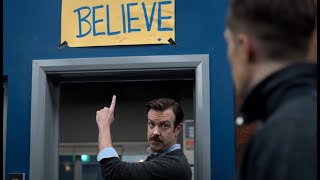
Most catchphrases die the week the internet finishes chewing them. Ted Lasso did something rarer. It smuggled coaching philosophy into comedy timing, then left the lines sitting in your chest after the laugh landed.
This is not every quote that went viral. This is the shortlist that still works when the room is cold, the week is heavy, and nobody is filming a TikTok. Eight Ted-isms. Zero nostalgia tax.

“Believe”
The yellow sign taped over the locker-room door. Season one onward. Less slogan, more operating system.
Believe still holds because it is not blind cheer. On this show, belief is a practice you choose after evidence has already hurt you. You hang the word where people change clothes so the reminder is physical. Before Season 4, that matters again: new team, new pressure, same demand to walk into the building like the result is not the only story.

“Be a goldfish.”
Ted to Sam after a mistake. The happiest animal on Earth, Ted says, has a ten-second memory.
Sports culture loves the myth of carrying every failure like a badge. Goldfish is the opposite: flush the error fast enough that it cannot become identity. It still holds in work, gaming, creative drafts, anything with a next possession. You are allowed to learn without living in the clip forever.

“Be curious, not judgmental.”
Ted to Rebecca, framed as Walt Whitman, later proved in a dartboard ambush against Rupert.
This one aged into a life skill. Curiosity keeps you from writing people off at first glance. Judgment feels smart in the moment and usually costs you information. In a culture optimized for hot takes, asking one more question is almost radical. It also remains the show’s moral center: Ted wins rooms by paying attention, not by being the loudest.

“I think it’s the lack of hope that kills you. I think it’s the belief that there’s nothing you can do that kills you.”
Ted answering the old pub wisdom that “it’s the hope that kills you.”
Cynicism still sells itself as maturity. Ted’s flip still cuts cleaner: hope is not the trap, resignation is. You can feel that line in any fandom, any season drought, any project that almost did not happen. Season 4 exists because somebody refused the lack-of-hope ending.

“Doing the right thing is never the wrong thing.”
Ted, repeatedly, when the clever option and the decent option are not the same option.
It sounds simple until you are the one with something to lose. The line holds because it collapses the spreadsheet argument. Decency is not a brand voice. It is a decision you make when nobody will clap. Richmond’s best arcs bend around people learning that sentence the hard way.

“For me, success is not about the wins and losses. It’s about helping these young fellas be the best versions of themselves on and off the field.”
Ted defining the job while everyone else is counting points.
Leaderboards are loud. Character work is quiet. This still holds for coaches, managers, parents, and anyone building a team that has to survive after the highlight reel. The show never pretends results do not matter. It insists people matter more, and then it pays that claim off in the writing.

“I hope that either all of us, or none of us, are judged by the actions of our weakest moments, but rather by the strength we show when and if we’re ever given a second chance.”
Ted, after Nate’s betrayal arc makes forgiveness expensive.
This is the heaviest Ted-ism, and the one that still feels adult. It does not erase harm. It refuses to freeze a person at their worst frame. Online life is built to do the opposite. The line holds because it asks for courage from the person who was hurt and accountability from the person who did the hurting. Both at once.

“Taking on a challenge is a lot like riding a horse, isn’t it? If you’re comfortable while you’re doing it, you’re probably doing it wrong.”
Ted, turning discomfort into a signal instead of a stop sign.
Self-help loves ease. Growth usually feels like bad posture and a loud heartbeat. This still holds whenever you start something that could embarrass you: a new role, a hard conversation, a season that might not work. Apple’s Season 4 brief is leap before you look. This is the body-feel version of that brief.
What these eight are really for
Ted-isms fail when you treat them like posters for people who already feel fine. They work when they are tools under stress. Goldfish for the mistake you just made. Curiosity for the person you want to dismiss. Second chances for the relationship that got ugly. Believe for the morning you would rather stay cynical.
That is why they still hold up while softer internet optimism evaporated. The show earns the lines with consequences. Characters get hurt. People relapse. Kindness costs something. The quotes survive because the drama around them is not soft.
If you are gearing up for Season 4, keep this list nearby. New roster. New pressure. Same question on the wall. For the full premiere map, cast returns, and Sudeikis in his own words, read the Season 4 deep dive.
Field note: the best Ted-ism is the one you can use without performing it. Say it quieter. Mean it harder.